Price the Case, Not the Call
- Written by
- Sudip Chakraborty, Founder, Kalmi
- Published
- Reading time
- 6 min read
On 19 October 2026, Santander said that in selected experimental use cases, moving to smaller specialised models had cut serving cost from around €5 per interaction to approximately €0.03, with performance maintained. That is a fall of more than 99 percent. NVIDIA's global banking lead, announcing the work with the bank, called cost per intelligence output "a key metric". For a model, it is. For the workflow a lender or a capability centre is deciding whether to fund, it is close to the wrong one.
What the number says, and what it does not
The figure is real and it is narrow. Santander describes the use cases as selected and experimental, and the work sits in its AI Lab, which tests technology before wider deployment. The number covers serving cost: the model chosen and the compute it runs on. A separate customer service experiment cut costs by more than 50 percent while improving conversation quality. None of this is a criticism. A lab measuring the cost of serving a model is measuring the right thing for a lab.
The direction is not in doubt either. Stanford's 2025 AI Index estimated that the price of querying a model at GPT-3.5 level fell from $20 to $0.07 per million tokens between November 2022 and October 2024. Inference keeps getting cheaper, and Santander's result shows what a bank can do when it chooses and serves models with care. The same report carried a less quoted finding: among organizations using AI in service operations, 49 percent reported cost savings, and most of them put those savings below 10 percent. Cheap models and small savings sit side by side.
The question for a business owner is what happens to everything else in the workflow once the model is cheap.
Where the cost of a case sits
At €5 an interaction, about ₹525 at current rates, a workflow that called a model five times a case would have spent more than ₹2,600 on model fees alone, many times what an analyst in an Indian operations centre costs to do the same work by hand. At €0.03, about ₹3, the model becomes a small line. From that point the cost of a case is set by the parts the model price does not touch: the minutes a person spends reviewing output, the cases that fall out as exceptions and are handled by hand, the cases that come back because they were wrong, and the cost of running the workflow with the controls a regulated institution needs.
An illustrative calculation makes the shape visible. Take an operations case such as a reconciliation break or a periodic KYC refresh, handled manually in 12 minutes by an analyst whose loaded cost is ₹600 an hour. That is ₹120 a case.
Now add AI the way many first deployments do, into the existing process. Five model calls a case at Santander's experimental rate cost about ₹15. Every case is still reviewed by a person for three minutes: ₹30. A quarter of cases fall out as exceptions and are handled by hand at the full 12 minutes, which averages ₹30 across all cases. Five percent are reopened and reworked at 20 minutes each: ₹10. Monitoring, logs and controls add ₹5. The case now costs ₹90. The model is a sixth of it, and the saving against the manual process is 25 percent, not 99.
Redesign the same workflow. Route review by risk, so a person sees 20 percent of cases before they execute: ₹6. Fix the upstream data and rules that generate exceptions, so they fall to 10 percent: ₹12. Rework falls to 2 percent: ₹4. Add a verification step, which raises model cost to about ₹20, and keep controls at ₹5. The case costs ₹47, 61 percent below the manual process. Model spend went up. Cost per case nearly halved.
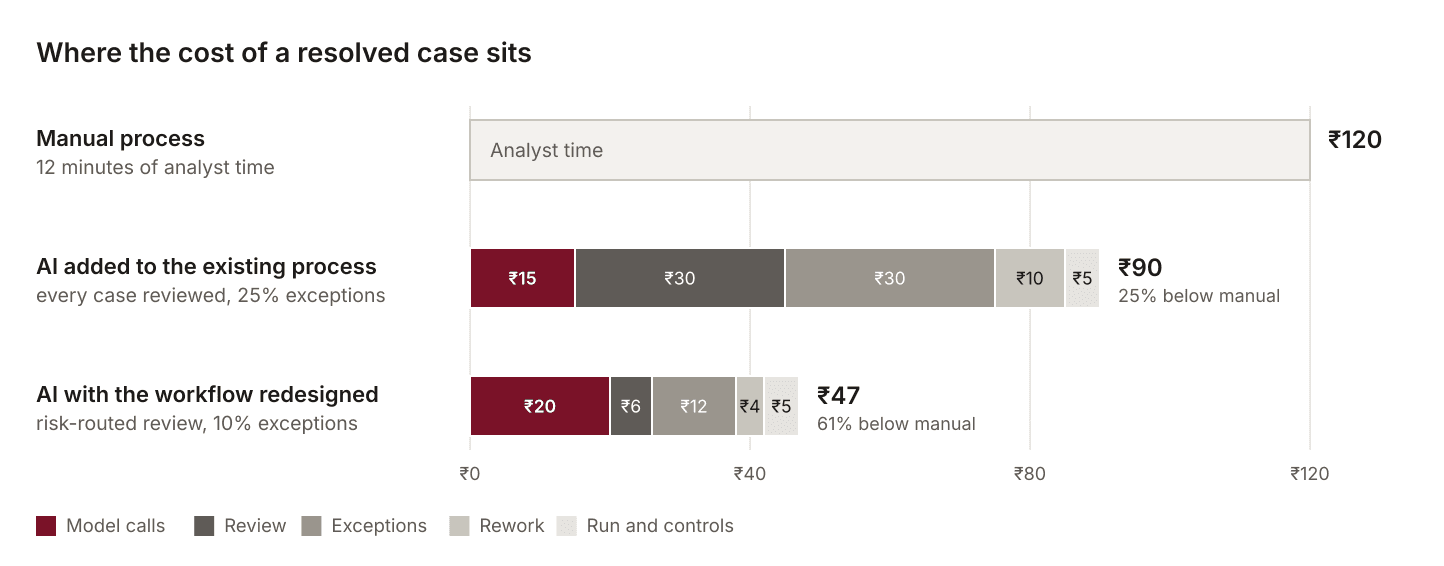
These inputs are assumptions, not measurements, and every workflow will have its own. The proportions move with the inputs. The direction does not, as long as people still touch a meaningful share of cases, because in an Indian cost base a few minutes of a person's time now cost more than all the model calls a case needs. A further 99 percent cut in model price would save at most ₹15 in the first scenario. Halving the exception rate saves as much, and that is a design decision the institution controls.
The measure that holds up
The measure that survives cheap inference is cost per resolved case: everything the workflow costs to run, divided by the cases it resolves to the standard the business and risk functions have agreed.
The numerator counts model and compute, review time, exception handling, rework, and the run cost of monitoring, logging and support. One-off costs of redesign, deployment and training are amortised over expected volume and reported alongside, not hidden in it.
The denominator counts only cases resolved to the quality bar and not reopened within a defined window. A case closed wrongly is not resolved. Its rework stays in the cost; the case itself does not count as output. This is the part most value cases leave out, and it is the part that keeps the measure honest.
The same measure is taken for the manual process before deployment, not reconstructed afterwards from memory.
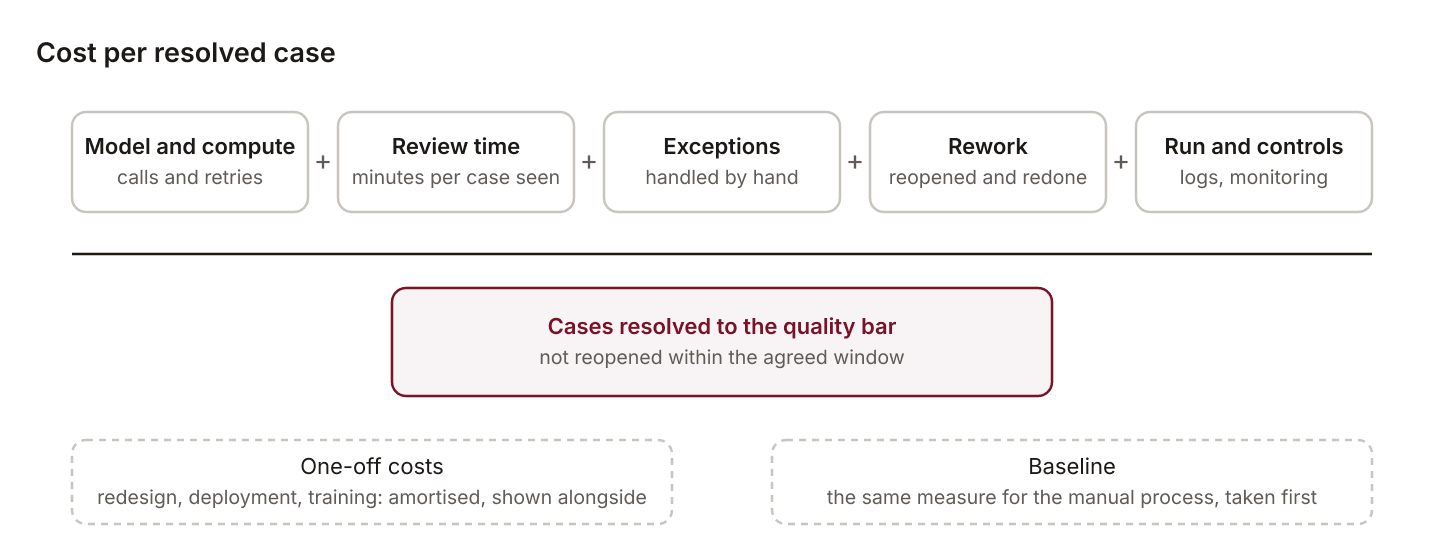
The denominator is what protects quality. A measure of cost per interaction rewards a workflow that answers fast and cheaply whether or not the answer is right. In May 2025 Klarna's chief executive said cost had been "too predominant an evaluation factor" in its push to automate customer service, and that the result was lower quality; the company began hiring people again. A measure that only counts cases resolved to a standard puts that trade on the same page as the saving.
What it changes in a value case
Three things follow for anyone writing or approving one.
The business case is written in minutes and rates, not tokens. The levers that decide whether a workflow pays are the share of cases a person touches, the minutes per touch, the exception rate and the rework rate. Each is a design decision about the work, which is why AI added to an unchanged process so often saves a fraction of what the pilot promised.
Good controls are part of the economics, not a tax on them. Review thresholds, decision logs and a kill path have a run cost, and it belongs in the numerator. But routing review by risk is both a better control and a cheaper one than reviewing everything, as The Reviewer Who Stopped Reviewing argued. The expensive design is blanket review that has stopped working.
Cheap models make it cheaper to build pilots that will never pay. Gartner predicted in June 2025 that more than 40 percent of agentic AI projects would be cancelled by the end of 2027, citing escalating costs, unclear business value and inadequate risk controls. Falling model prices do not change that arithmetic, because the costs that sink a project are the ones above. Measuring cost per resolved case at triage, with the review and exception rates the risk function will actually sign, is how to find the small share of use cases worth pursuing now before money is spent on the rest.
The test
Pick any AI workflow already running and ask three questions. What does a resolved case cost now? What did it cost before? How much of the difference came from the model? If nobody can answer the first, the value case is still a forecast. If the answer to the third is most of it, the work itself has not yet been redesigned.
- Santander builds AI capabilities that improve performance and lower costs using NVIDIA AI infrastructure, Banco Santander, 19 October 2026
- Crédit Agricole expands AI agents, Santander reports lower model costs, The Asian Banker, 23 October 2026
- The 2025 AI Index Report, Stanford Institute for Human-Centered Artificial Intelligence, April 2025
- Klarna focuses on human-powered customer service, PYMNTS, 8 May 2025 (on the chief executive's Bloomberg interview)
- Gartner predicts over 40% of agentic AI projects will be canceled by end of 2027, Gartner, 25 June 2025